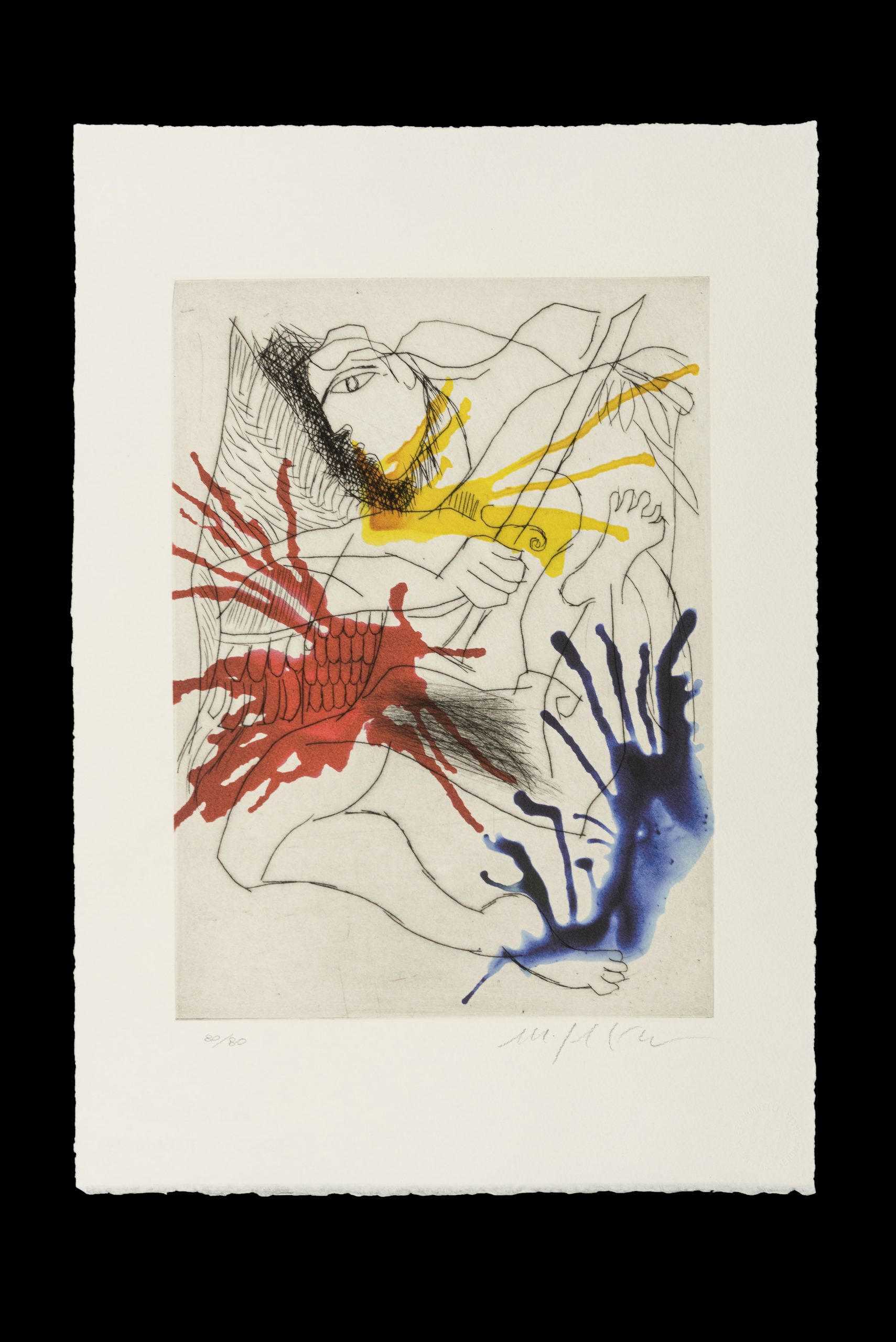
Mimmo Paladino. Görlitz – Stalag VIII A – 15 gennaio 1941
From January 15 to February 28, 2026, The Shoah Memorial of Milan, in collaboration with Art Commission and Edizioni Colophonarte, hosts the exhibition Mimmo Paladino. Görlitz – Stalag VIII A – January 15, 1941, as part of the 18th edition of the series Segrete. Tracce di Memoria.
English texts for international visitors are provided below.
Senato della Repubblica
Senatrice a vita Liliana Segre
La Musica e la Morte
This is an important work dedicated to Quartetto per la fine del Tempo by Olivier Messiaen, performed in 1941 in the Nazi Stalag of Görlitz. It was a detention camp for military prisoners, in which deaths between 1939 and 1945 were counted in the tens of thousands.
And yet 1941 was a year before the Wannsee decision on the Endlösung. And Görlitz was not Auschwitz.
Nevertheless, the concert of 15 January 1941, featuring music composed by Messiaen specifically for that occasion, represents a historic event. A miracle, given the conditions under which it took place, but also a precedent.
This book, which recalls that event, is important for the many elements it brings together and enhances: graphic works evoking the eternal gigantomachy between Spirit and Death; a text that recalls the conditions under which Messiaen produced his work; and above all the reference to a music that even today is listened to with pleasure and deep emotion. Taken as a whole, this work also constitutes a warning—an opportunity to reflect on how, in the twentieth century of totalitarianisms, music and culture too could become victims of deliriums about “degenerate art” and a not insignificant instrument of policies of persecution and extermination.
Indeed, it is well known that in the Nazi concentration hells the executioners encouraged the organization of musical bands and choral groups; in Theresienstadt, entire opera seasons were even organized. It was a diabolical way of making the reality of the camps truly totalitarian—that is, capable of compromising the whole of human existence, both material and spiritual. Among other things, the presence of small orchestras made up of prisoners also served to better disguise, during the sporadic visits of the Red Cross, the true nature of those places.
Thus it could happen, for example, that Viktor Ullmann, an Austrian composer of Jewish origin, only a few months before his death completed a composition on a text by Rainer Maria Rilke entitled The Lay of the Love and Death of Cornet Christoph Rilke, as well as a true “camp opera” entitled The Emperor of Atlantis. This, however, did not spare him the gas chambers of Birkenau.
Messiaen’s quartet represents precisely a direct antecedent of all this: an authentic experimentum in corpore vili, through which the Nazis sought to understand how, in the extreme sharing of imprisonment, forms of “creative” involvement of certain detainees might be experimented with—such as to provide entertainment for the executioners, but above all to facilitate the more efficient management of their criminal plans of extermination.
For us, therefore, it is not only necessary to remember. It is also necessary to recover the authentic meaning of music, art, and culture as the highest expressions of human freedom and creativity—an antidote against all subcultures of Death and Violence. This is the best way to oppose totalitarian barbarism not merely with a routine condemnation, but with the sensibilities of a higher level of civilization and human dignity. So that it may still and always be said of all of us: “You were not born to live like brutes.”
Liliana Segre
Sandro Cappelletto
QUARTETTO PER LA FINE DEL TEMPO –
A NARRATIVE FOR THE MUSIC OF OLIVIER MESSIAEN
You who live safe
In your warm houses,
You who, returning home at night,
Find hot food and friendly faces.
Consider whether this is a man
Who works in the mud,
Who knows no peace,
Who fights for half a loaf of bread,
Who dies for a yes or for a no.
We are our memory. What we choose to remember, what we prefer to erase. Quartetto per la fine del Tempo. First movement – Liturgie de cristal – Between three and four in the morning the birds awaken. A blackbird, a solo nightingale improvises, surrounded by a dusting of sounds, by a halo of trills lost up there among the trees.
It is the silence of the sky, the secret silence of its harmony.
Then I imagined a “Vocalise for the Angel who announces the end of Time.” I evoked, at the beginning and at the end of this piece, the power of that Angel, wrapped in the rainbow, clothed in clouds, who places one foot on the sea and the other on the earth.
In the middle, at the center, dwell slowly the impalpable harmonies of heaven.
This quartet was first created in Barrack 27B of the Stalag at Görlitz, in Silesia, where I had been taken by the Nazis. Today, the city is half German territory and half Polish: a river divides it and unites it.
It was 15 January 1941, bitterly cold; the camp was buried under snow. We were thirty thousand prisoners of war, mostly French, with Poles, Belgians, and Serbs. Later the English, the Russians, and the Italians would arrive.
Frenchmen from Europe, Asia, and Africa: Christians, Jews, Muslims.
All locked in there, prisoners, humiliated every day. We played on broken instruments: I remember that evening the cello had only three strings, and the keys on the right-hand side of my piano—which I had found while fixing up a barrack—went down and would not come back up. Our clothes were unbelievable; to distinguish me they made me wear a torn green uniform taken from a Czechoslovak soldier. But there was nothing better. I wore wooden clogs, good for walking on snow.
The audience represented every social class: doctors, petty bourgeois, career military men, workers, peasants. All men.
I want to recall the names of those magnificent musicians: Jean Le Boulaire was on the violin, Henri Akoka on the clarinet, Étienne Pasquier played the cello—which he had bought in the Görlitz music shop; it cost sixty-five marks, collected by his barrack mates so that he could play, for himself and for them. I sat at the piano.
On a small slip of paper, at the end of the concert, we wrote dedications to one another, to remember that evening forever.
Henri was of the Jewish faith; his father, Abraham, would be deported and murdered at Auschwitz; Henri would manage to escape and survive. Étienne said he was agnostic: “But I believe in divinity. Schubert’s music is divine.” Jean considered himself an atheist. I am a Christian, a believer. Even our political opinions were quite different.
I wrote a quartet for the musicians and instruments I had, so to speak, at hand. I needed to think about music, to make it, in order to feel alive.
I began from an image I loved deeply, that of the Angel who announces the end of Time. The Abyss is time, with its sorrows, its weariness. Birds are the opposite of time: they are our desire for light, for stars, for rainbows, for jubilant vocalises.
A recommendation to musicians: do not fear anything that makes an interpretation alive and sensitive. Play with imagination.
In the name of the Apocalypse, my work has been reproached for its calm, its stripped-down character, even its joy. My detractors forget that the Apocalypse does not contain only monsters and cataclysms. It also holds silences of adoration, marvelous visions of peace:
“And when he opened the seventh seal, there was silence in heaven for about half an hour.”
With my music, I never intended to create an apocalypse. I was already living my apocalypse—ours: the revelation of evil. Of the lords of evil.
Fifth movement: a great phrase, infinitely slow, of the cello magnifies with love and reverence the eternity of a powerful and gentle Logos, “whose years will never fade.” The melody unfolds: “In the beginning was the Logos, and the Logos was with God, and the Logos was God.”
In the Book of Revelation certain mysterious images appear:
“And I saw another mighty Angel coming down from heaven, wrapped in a cloud; above his head was the rainbow, his face was like the sun and his legs like pillars of fire. He held in his hand a little open book and set his right foot on the sea and his left on the earth, then he cried out like a roaring lion. At this cry the seven thunders made their voices heard. And when the seven thunders had spoken, I was about to write, but I heard a voice from heaven saying: ‘Seal up what the seven thunders have spoken and do not write it.’
Then the Angel whom I had seen standing on the sea and on the earth raised his right hand toward Heaven and made this oath:
Oti kronos ouketi estai.
There shall be no more delay of time; but in the days when the voice of the seventh Angel is heard and when he is about to sound the trumpet, then the mystery of God will be fulfilled.”
When I was a prisoner, the lack of food caused me to have colored dreams: I saw the Angel’s rainbow and mysterious whirlings of color. “There shall be no more delay of time”; time will be exhausted. The choice of the Angel who announces the end of Time rests on deep reasons.
As a musician, I have always worked on rhythm. Rhythm is, by its very nature, change, division. To study change and division means to study time: time—determined, relative, physiological, psychological—divides itself in a thousand different ways, and for us humans the most immediate is a continual conversion of the future into the past: memory, and we are our memory.
Only the sword that inflicts the wound can heal it. Our memory.
What problems. In eternity they will no longer exist; yet they are the problems I posed to myself in my Quartet.
Quartetto per la fine del Tempo is divided into eight movements. Seven is the perfect number, the creation of six days sanctified by the divine Shabbat; the Seven of this rest extends into eternity and becomes the Eight of unfailing light, of peace that cannot be profaned.
The broad slow phrase—very slow, ecstatic—of the violin recalls the cello solo we have already heard. One must sustain this slowness, not flee from it.
The music slowly rises toward the highest registers: it is the ascent of man become God toward the blaze of salvation.
But in the end: all this remains an attempt, nothing more than a stammer, when we think of the greatness of the subject, which overwhelms us.
Oti kronos ouketi estai.
How many times, in those days, I thought that the end of my time had come.
That evening, after the concert, a prisoner approached us and said: “This music redeems us all. It does not take us back to where we are, but to what we are. Human beings.”
Before being enemies—before killing and being killed—before unleashing hatreds that do not die out—human beings.
The Angel who announces the end of Time: his mystery cannot be represented, cannot be seen. It is a mystery that calls for music.
Music, the sublime sign of our transience, of our hope.
Biographies
Domenico “Mimmo” Paladino (Paduli, 1948)
A multifaceted artist—sculptor, painter, photographer, filmmaker, and printmaker—he is among the leading figures of the Transavanguardia movement theorized by Achille Bonito Oliva and introduced to a wide audience with Aperto 80 (Venice Biennale, 1980). His research engages in dialogue with references ranging from primitive art to contemporary language, within a constant experimentation with materials and space.
He has taken part several times in the Venice Biennale and, in 1982, in Documenta 7. His works are held in prestigious international collections, including the MoMA and the Metropolitan Museum of Art in New York, and Tate Modern in London.
Olivier Messiaen (1908–1992)
French composer, organist, teacher, and ornithologist, he was one of the leading figures in the musical landscape of the twentieth century. Thanks also to his long activity as a teacher, he exerted an extraordinary influence on composers of subsequent generations. In 1940, after the outbreak of the Second World War, he was imprisoned for nine months in Görlitz at the internment camp Stalag VIII-A, where he composed Quatuor pour la fin du Temps (1940–41) for the instruments available in the camp: piano, violin, cello, and clarinet. The title of the work is inspired by a quotation from the Apocalypse of John, in which the angel announces the end of Time.
After returning to France, he was appointed professor of harmony and later of composition at the Paris Conservatoire, where he taught from 1941 to 1978. Alongside chamber, symphonic, and theatrical compositions, Messiaen left a large body of writings on music—particularly on rhythm—collected and published after his death under the title Traité de rythme, de couleur et d’ornithologie.
Liliana Segre (Milan, 1930)
She is one of the most authoritative witnesses to the Shoah. Arrested at the age of thirteen and deported to Auschwitz-Birkenau in 1944 because of the Italian racial laws, she was among the very few Italian Jewish children to survive the extermination camps. After returning to Italy, she remained silent for many years before devoting herself to public testimony, especially among younger generations, to preserve the memory of the Holocaust and promote the values of democracy, human dignity, and responsibility.
In 2018 she was appointed Senator for Life by the President of the Italian Republic for her outstanding contributions in the social field. She has received numerous national and international honors. Through her civic commitment and her words, Liliana Segre has become a moral reference point in contemporary Italian and European culture, and a powerful voice against indifference, hatred, and all forms of discrimination.
Sandro Cappelletto (Venice, 1952)
Writer and music historian. He holds a degree in Philosophy and studied harmony and composition with Robert Mann. He is the author of theatrical texts and works for musical theater, created in collaboration with some of the most significant composers of our time. A professional journalist and a member of the Accademia di Santa Cecilia.